Guide
Schengen visa photo requirements
Who sets the rules
The EU Visa Code (Regulation (EC) No 810/2009) requires a photograph with every application. Article 13 says its technical requirements follow the international standard in ICAO Document 9303, the same standard used for passport photos worldwide.
The details, such as how many photos and which background colour, are written by the consulate of each Schengen country or by the visa centre it works with. Their checklists mostly agree, but not word for word. The rules below are taken from German and Czech official pages; check the checklist for your own consulate before you print.
The usual requirements
| Rule | What official pages say |
|---|---|
| Size | 35 × 45 mm (German Missions in India, German Embassy Dar es Salaam, Czech Foreign Ministry) |
| Face size | 70–80% of the photo; 32–36 mm from the chin to the top of the head, not counting the hair (German Foreign Office) |
| Eyes | At least 13 mm from the eyes to the bottom of the chin (Czech Foreign Ministry) |
| Background | White or grey (India); light-coloured (Dar es Salaam) |
| Age of photo | Not older than 6 months |
| Glasses | Allowed if the eyes are clearly visible, with no reflections or tinted lenses; no sunglasses |
| Head covering | Only for religious or health reasons, and it must not prevent identification |
| Clothes | Civil attire |
| Number | At least one (German Missions in India); check your checklist |
The photo and fingerprints at the visa centre
Schengen countries store each applicant’s photo and fingerprints in the Visa Information System. The German Embassy in Colombo explains that applicants must appear in person to give this biometric data (a photo and ten fingerprints). Children under 12 are exempt from fingerprinting, and fingerprints can be reused for applications made within 59 months.
The German Missions in India add that the photo can be taken digitally when you apply, or scanned from a recent photo that meets the ICAO standard. In practice, bring a printed photo even if the centre also takes one: most checklists still list it, and a missing photo can stop the appointment.
Where consulates differ
- Background colour. Some say “white or grey”, others just “light”. A plain light grey or white wall works for both.
- Number of photos. One is common; check whether your checklist asks for more, and bring a spare.
- How the face is measured. The German guidance measures chin to the top of the head without the hairstyle; the Czech page gives a minimum eye-to-chin height. A photo cropped to the ICAO standard meets both.
- Who takes your application. Many consulates use a visa centre. Its checklist for your country of residence is the one that counts, so read the version dated for this year.
Make a Schengen visa photo with Picsawa
- Open the Schengen visa photo tool and add a front-facing photo taken against a plain light wall.
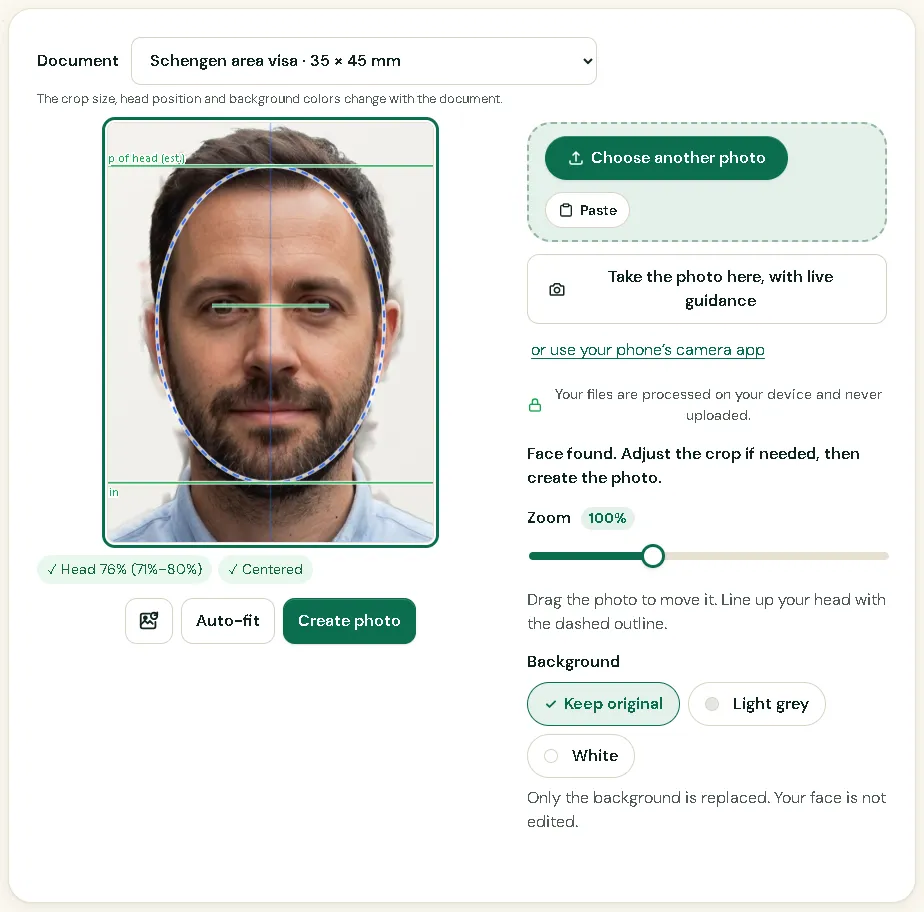
- The crop is set to 35 × 45 mm with the face inside the ICAO range, and guides show the head position.
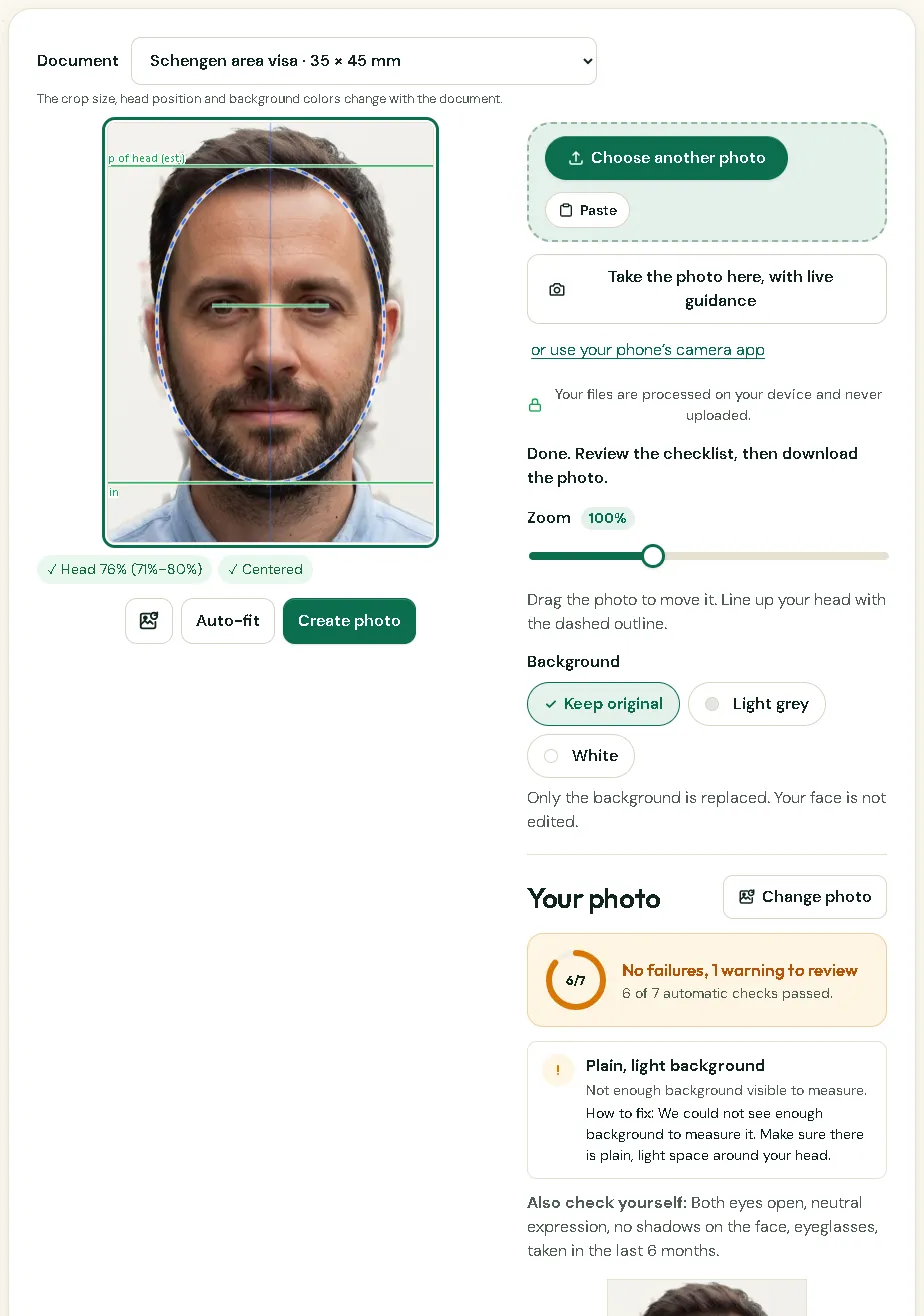
- Keep the original background if it is already plain and light, or choose light grey or white.
- Create the photo, read the checklist and download it (413 × 531 pixels, 35 × 45 mm at 300 DPI) or a print sheet: 8 photos on 4 × 6 in, 10 on 5 × 7 in or 32 on A4.
Nothing is uploaded. For printing tips, see how to print passport photos at the right size.
Common reasons a photo is refused
- The wrong size. A U.S. 2 × 2 inch photo (51 × 51 mm) is square and doesn’t match 35 × 45 mm.
- A face that is too small, such as a head-and-shoulders photo with lots of space above the head.
- Shadows on the face or behind the head, and glare on glasses.
- An old photo reused from a previous visa or passport.
- Edited photos: smoothing, filters or a changed face shape.
- A poor print with visible pixels or on ordinary paper.
How it looks in Picsawa
Screenshots of the free Schengen area visa photo maker tool, made with sample photos.
Sources
- EUR-Lex — EU Visa Code, Regulation (EC) No 810/2009
checked 7 November 2026 - German Foreign Office — Biometric passport photos (PDF)
checked 11 October 2026 - German Missions in India (diplo.de) — Schengen visa FAQ
checked 7 November 2026 - German Embassy Dar es Salaam (diplo.de) — Schengen visa
checked 7 November 2026 - German Embassy Colombo (diplo.de) — Visa Information System (VIS)
checked 7 November 2026 - Ministry of Foreign Affairs of the Czech Republic — Visa photo
checked 7 November 2026
Picsawa is not affiliated with any government. The issuing authority makes the final decision, so always check its official instructions before you submit.
Frequently asked questions
Can I use a U.S. 2 × 2 inch photo for a Schengen visa?
No. Schengen consulates ask for 35 × 45 mm, which is narrower and taller than the square U.S. size. Make a new photo at 35 × 45 mm.
Can I wear glasses in a Schengen visa photo?
Usually yes, if your eyes are clearly visible, with no reflections and no tinted lenses. Sunglasses are not allowed. Taking glasses off avoids glare.
Can I wear a hijab or other head covering?
Yes, for religious or health reasons, as long as your whole face is visible from the chin to the forehead and the covering does not prevent identification.
Should the background be white or grey?
Official pages say white, grey or light-coloured. A plain light grey or white background is accepted by the checklists we checked; follow your consulate’s if it names one colour.
Do I need a photo if the visa centre takes my picture?
Bring one anyway. Most checklists still list a printed photo, even where a digital photo is taken with your fingerprints.